


Suffolk County Council have been working to develop personalised technology to assist the person you care for, wherever they are and provide them and their support network with peace of mind, real-time information and a monitoring and response service should it be needed.
This technology, known as Cassius, offers an innovative care solution to help the person you care for live independently. Cassius can help them stay safe and well at home and help provide some extra help and support to you. If the person you care for is about to be discharged from hospital, Cassius can also help them get home quickly and safely.
Cassius can help the person you care for with many aspects of their life including personal safety and security, providing daily reminders, keeping track of their whereabouts, helping them find their way around and keep them in contact with you and other family members.
Te Cassius service is for people over 18 who may need additional support to live independently in their own home. To find out more about Adult Social Care services, including technology, please go to http://www.suffolk.gov.uk/Cassius-Eligibility or for more information please contact Customer First on 0808 800 4005.
The Cassius suite of technology includes the following:
Digital Reminder Clock – This device provides picture reminders for daily routines and can include reminders to take medication, to drink more liquid or to have a wash. Reminders can be customised to meet the needs of the person you care for and as many as required can be set, as daily, weekly, monthly or one off.
The device has a large screen that shows the day, date, and time and also reminder notifications at the correct time. It will announce when the reminder is on the screen so it can also be heard.
Sensors – These are small devices which can detect movements and help people live independently. The Cassius sensors do not use a camera, video, or microphone and can be used in rooms or on doors to alert you if there is a change in the routine or regular activity of the person you care for.
For example, a sensor can be used to show when the person you care for goes out and returns home so that you know they are safe. They could also show if a door is accidentally left open, alerting you and/or the person you care for.
Additional devices can be used alongside the sensors to offer extra safety at home. These include sensor plugs, which can show if electrical appliances are being used and “Press Me” Buttons that can be placed around the home to call for help quickly should it be needed.
Video Carephone – This is an easy-to-use tablet that allows the person you care for make two-way video calls with family, friends and other members of their support network by simply touching a picture on the screen. Friends and family can make calls to them through the an Online Portal and App.
The carephone can also be used to set reminders, receive messages and has the ability to access the Internet. It comes with a SIM Card installed so no broadband is required at the persons home.
Fall Monitors – Available as either a wearable device or a device linked by Bluetooth to the video carephone these monitors allow help to be reached quickly and easily. Both styles are fitted with fall detection technology and will automatically raise an alarm should the person you care for fall.
The wearable device is fitted with an inbuilt SIM card and allows a call for help to be made either at home or when out and about.
The Bluetooth device is linked to the video carephone and is designed for people who spend the majority of their time at home. It needs to be in range of the carephone to raise an alarm
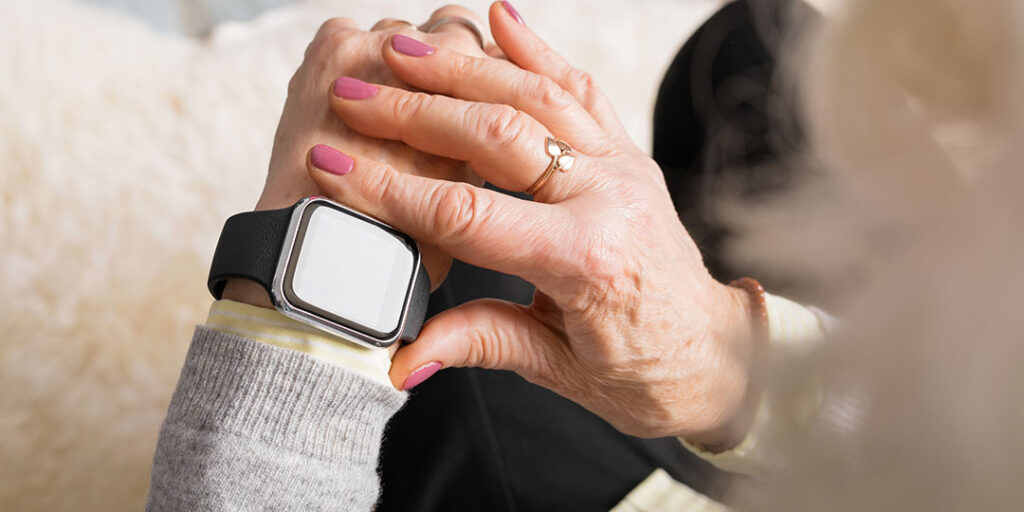
Smartwatch – This is a standard watch (analogue or digital) that allows the person you care for to call for help in an emergency, either at home or out and about. The smartwatch monitors movement and can alert you if there has been reduced movement. It can be linked to a monitoring centre.
The Smartwatch has an inbuilt SIM card and GPS tracking feature that will you to find the person should they get lost or be unable to tell you where they are. This can also be used for “geofencing” – a feature that provides a geographical boundary and sends an alert should the person you care for move outside this area.
Digital bed and chair mats – These are placed on a bed or chair under a sheet or cushion. The mats can send an alert to your phone or computer to let you know if the person you care for has got up or not returned to bed. These do require an internet connection to work but devices can be provided to ensure they are connected.

