For children, it is normal that when something is bothering them they can find it difficult to talk about. Perhaps they do not feel ready to talk or they feel awkward when the attention is directly focused on them. Maybe they don’t have the words to explain how they are feeling.
Emotional Literacy (being able to talk about feelings) takes time to develop for a child. As adults, we can help them to learn about different feelings, how each feeling ‘feels’ and give names to their feelings.
Feelings Chart – 20 Free PDF Printables
These example visual resources can be printed and displayed on a kitchen cupboard or saved as a photo on your phone.
“Point to how you are feeling today…Can you tell me/ I wonder what made you choose that face? “
By doing this you are showing the child you are interested in them and how they feel. You can help to give a name to the feeling, plus you are helping the child to identify what events may have contributed to how they are feeling.
This activity can also help you and the child to notice patterns in their emotions. It is important you practise this exercise with the child regularly to ensure it is not just when they are experiencing negative emotions (sad, angry). Building their emotional language and helping them to identify all emotions is a valuable development skill for children.
Remember to share with the child which face you have chosen so they know adults have feelings too.
Using a paper plate or circle of paper, you can ask they child to draw a face that may not be on the page. “What does your face look like when you are happy/frightened?”
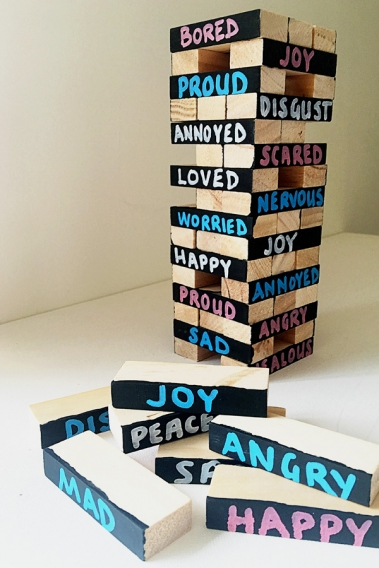
Feelings Jenga
This is a game which can be played in pairs or larger groups. Joining in with the child(ren) playing helps to model how you as an adult talks about your feelings. This activity demonstrates that feelings and how/when we experience them are different for different people, we are not all the same.
- Write on Jenga blocks various emotions words: Happy, sad, proud, excited, nervous, shy…
- Build your Jenga tower. (If you can’t source a Jenga set, the game is just as effective using cardboard boxes which you can save and tape the ends together to form stacking cubes).
- Take it in turns to take a block from the tower without causing the tower to topple.
- Read the word on the cube. The player must recall a time they have felt that emotion, for example “I felt proud when…/ I was scared when…”
You may choose to extend their go by asking them how it feeling felt, for example: “How does scared feel to you? What does your body do?” (e.g. you may clench your fists, your heart may beat faster)