


There are often many stereotypes about Autism. “Boys are more obvious and show more disruptive behaviour. There are less girls with Autism.”
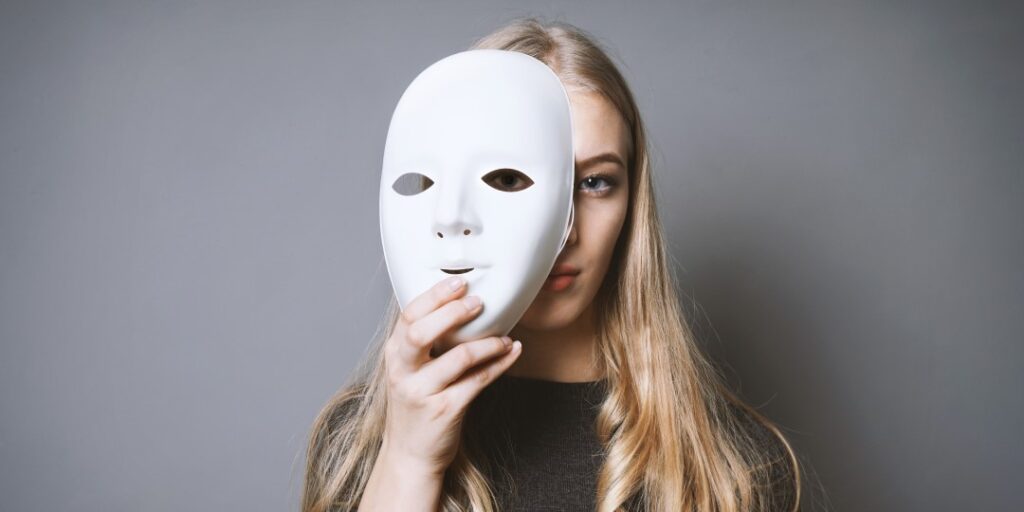
Historically girls have been more difficult to recognise as being autistic. I often hear many people say that girls go undiagnosed or are diagnosed later in life because they present differently to boys. You will often hear that girls tend to ‘Mask’. Ok, but what is ‘masking’?
The easiest way to describe masking is that most adults have what they would call their ‘work phone voice’ – the voice you use to speak to clients, customer, service users on the phone. Most people have a different voice they use on the phone when they talk to family, or as I like to explain it – you camouflage your common voice to make yourself sound more important or intelligent. This is similar to ‘Masking’. Masking is basically the ability for someone to camouflage or hide certain behaviours by mimicking the behaviours of the people around them in order to hide their true selves. Many women and girls aim to disguise their autism, their differences, their ‘weirdness’ so the world around them does not judge them as the ‘weird child’, the ‘strange one’, ‘the freak’, someone or something to fear.
Yes, girls do often ‘mask’ which can leave school, friends and even family not realising that there is something different about them, that they are struggling to fit in to the neurotypical world which leaves them vulnerable and easily misdiagnosed, leading to mental health issues or self-harm. Having worked in a school, I would often say that the quiet children in school were the ones that worried me because they were often struggling but they were not picked up, they are not causing the teacher any harm or disruption and they do not look like they need any help. However, people often forget that Autistic girls can also be aggressive, explosive, have meltdowns, be argumentative, struggle in certain situations and often struggle to regulate their emotions. Despite young girls presenting this way people are more likely to write them off as ‘just going through a phase,’ ‘hormonal’, ‘just one of those awkward kids’ or even just ‘horrible/mean/nasty’ and so on. Either way girls are often flying under the radar and are misdiagnosed and diagnosed with autism or ADHD less than boys. However, things are slowly improving for girls “In a 2017 study, Loomes and other researchers analysed existing prevalence studies and found that the male-to-female ratio was nearer 3:1.”
I often hear that boys can be more obvious and easier to diagnose and I have read many articles on masking, most of which talk about Autistic girls and masking, how girls and women are so good at camouflaging their autism and hiding it in school and to the outside world. However, throughout my journey this was not my experience of masking. I found it very isolating having a boy that masked so well. With only articles talking about Autistic girls and masking I felt like I must have been the only parent in the world experiencing this. When my son was in primary school (pre-diagnosis), I would often be told by the teacher that he had been ‘good and had a great day.’ Something every parent wants to hear as it makes them feel good. We would then go home and ‘WHAM’ the instant we got through the front door the meltdowns began, screaming, shouting, kicking, punching – my child was out of control. I would ask ‘What’s wrong?’ ‘What’s the matter?’ or even ‘your teacher said you’ve had a lovely day don’t go and spoil it now?’ Looking back now, not only is it the most ridiculous thing I could have said to him, but at that moment in time he could not hear or even begin to process a single word I was saying. I quickly started to realise that what the teacher was telling me was completely different to what my child was trying to tell me through his actions. It’s not that the teacher was lying or trying to deceive me, it was just that some of his strategies were so clever and subtle that they went unnoticed for such a long time, he would eat or chew on anything he could find, go to the toilet so many times the teacher questioned whether or not he had a urine infection, hide his lunch rather than eat it so he didn’t have to sit in the dinner hall any longer than needed. I soon realised my child was not ‘misbehaving’ in school, nor was he causing the teachers any problems throughout the day. I feel this made it easier for him go unnoticed for such a long time.
Although school had not realised that my child was masking, apart from the meltdowns at home, I had also realised that he had been chewing and eating things around the classroom. I would often have the conversation with the teacher in the morning and raise my concerns, I would explain that although he seems to be ‘managing’ during the day he is bottling it up then exploding when he gets home. That afternoon I would be met once again by the teacher emphasising how ‘he had been so good and had a great day’, and so the cycle continued. I started to get frustrated, I started to question ‘why are they not taking me seriously?’ ‘Why are they not listening to me?’, ‘How do they not see it?’, ‘How would I get a medical professional to listen to me about his behaviour when school do not see it?’, ‘Is it me, is it all in my head?’ It started to drive me crazy, no one other than me could see my child was struggling. After a few weeks into the school term, I had the same conversation with his teacher and as I lowered my head in despair, I noticed that my son had happily eaten through the front of his school shoes that day. YES! Finally, something they could see. I mentioned it to the teacher and she ignored me and continued to explain how lovely his day had been. As the weeks went on the teacher would raise concerns with me about the number of pencils my son had destroyed (eaten), or whether I would be able to ask him if he had eaten the class rubbers – as they had gone through two boxes in a week. Once the teacher started making these comments, I started to trust my own judgment again, I took the opportunity, rather than ‘fight’ the teacher, I logged everything and eventually took them to the teacher with the rest of my concerns, only to be told ‘he is fine, because there is another child that struggles more (than my child) as he has meltdowns at school and is more difficult for the teachers to manage. As you can imagine, he did not stay at that school, but then I often say not every school is right for every child.
When I was studying child development and child psychology, we had it ‘drummed’ in to us that every child is individual, every child has different needs and these needs should be recognised, and yet all these years later we are still trying see Autism as ‘boys present one way’ and ‘girls present another’, rather than realising that it makes no difference whether the child is a boy or a girl, neurodivergent or neurotypical, they are all individuals with their own needs so why are we not acknowledging these individual needs? I worry that these stereotypes prevent us and others from seeing the bigger picture, they give us preconceived ideas about what Autism is and how it should look. They prevent us from seeing a child that is struggling, because it has been suggested to us what an Autistic girl or Autistic boy should look like.
We need to educate people more with the idea that ‘if you have met one autistic person, you have met one autistic person’ regardless of whether they are male or female. Not every autistic person will spin or rock, they all have their own ways of coping that is unique to them. By thinking of every child as unique and individual we can better support and understand them, help them to create coping strategies to manage everyday life, as well as educate people to realise how important neurodivergent people are to the world and how we can best support them.
If you would like to find out more about masking check out these links
Chris Packham invites us inside his autistic mind – Shown on BBC2 in Feb 2023, Chris Packham meets other autistic people from across the UK and helps them create short films to reveal to their family and friends what’s really going on inside their minds.
Christine McGuinness: Unmasking my Autism – Shown on BBC1, in this heartfelt journey of self-discovery, Christine McGuinness uncovers a hidden world of thousands of autistic women who, like her, have been ignored by science and society.
Autistic people and masking -Dr Hannah Belcher is a lecturer, researcher, speaker and author. Here Hannah discusses masking in autistic people, based on research and her own personal experience.
Fitting the mask – Kayleigh describes her experiences of masking and fitting in.
Autistic women and girls -More women and girls than ever before are discovering that they are autistic. Many had been missed or misdiagnosed due to outdated stereotypes about autism. But that is slowly changing.
How to spot SEND pupils who are ‘social masking’ – Advice on how teachers can identify this key character trait in girls with autism spectrum disorder

